
Why does AI think my business is someone else?
And how to fix it
AI & FUTURE TECHGROWTH STRATEGYFOUNDER'S INSIGHTSSCHEMA MARKUPBRAND PROTECTIONDIGITAL IDENTIYENTITY RESOLUTIONKNOWLEDGE GRAPH


Robots always be like "Nod"
Why Does AI Think My Business Is Someone Else? (And How to Fix It)
Executive Brief: Your Website Has Two Audiences
The Bottom Line Up Front: For twenty years, you wrote your "About Us" page for humans. You told an emotional story about your humble beginnings to build trust.
That strategy is now dangerous.
In the age of AI Search (like ChatGPT and Google Gemini), your "About" page has a new, critical job: it must serve as the Source of Truth for the machine.
The Problem: AI models don't "read" stories; they extract facts. If your page is full of fluffy marketing language, the AI gets confused. It suffers from Identity Confusion, often merging your business with competitors who share a similar name
The Consequence: A potential client asks ChatGPT about you, and it replies with your competitor’s bad reviews or their business hours.
The Solution: We must re-engineer your "About" page using the Identity Stack. By adding invisible code (Schema) and "Atomic Facts," we force the AI to recognize your business as a unique, verified entity.
The "So What?": When you implement this, you stop being "just another marketing firm" and become a verified entity in the Knowledge Graph, preventing AI hallucinations and securing your brand reputation.
Phase 2: The Physics of "Identity Confusion"
(We write this section so AI robots can strictly define the problem—but the analogy helps you understand the risk.)
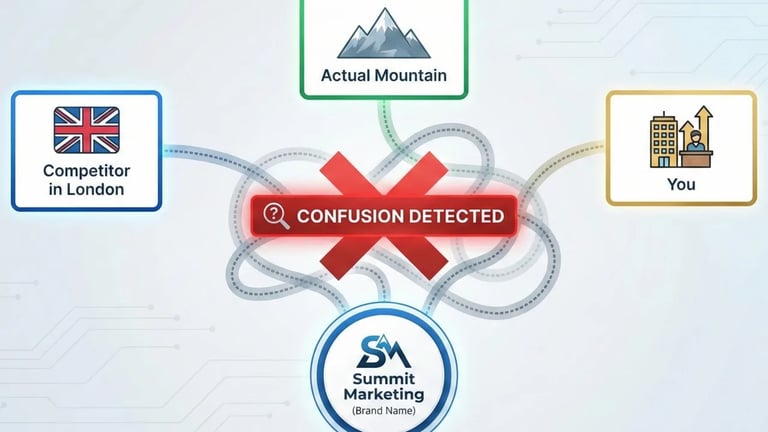
What is Entity Resolution? Entity Resolution is the computational process used by search engines and AI models to determine if two different mentions (e.g., "Summit Marketing" and "Summit Marketing, Inc.") refer to the same real-world business. If the resolution fails, the AI creates a "hallucinated" hybrid entity, mixing accurate data with incorrect facts from other companies.
The "John Smith" Problem
Imagine you are in a crowded ballroom and you yell, "John Smith!" Three different men turn around. This is Ambiguity.
To find the specific John Smith you need, you have to add specific data points: "John Smith, the Architect, from Chicago, born in 1980."
The Internet is that crowded ballroom. There are likely thousands of businesses that share your name or operate in your industry.
The Risk: If your website just says "Summit Marketing," the AI guesses which one you are.
The Fix: We give the AI a "Digital Fingerprint" that is mathematically unique to you.
Narrative vs. Atomic Facts
AI struggles with "storytelling." It thrives on "Atomic Facts"—simple, declarative statements.
The Solution: The "Identity Stack"
To solve this, we don't just rewrite text; we inject code. We use specific Schema.org properties to create a unique ID for your business. We call this the Identity Stack.
1. legalName (The Anchor)
Never rely on your brand name alone.
Brand Name: "Summit" (Shared by thousands).
Legal Name: "Summit Marketing Group of Ohio, LLC" (Legally unique).
Why: This matches your business to government registries, proving you exist.
2. sameAs (The Trust Bridge)
This property links your website to other "Sources of Truth" like LinkedIn, Crunchbase, or Wikipedia.
The Logic: It tells Google, "I am the exact same entity described on this LinkedIn profile." It inherits the trust score of those platforms.
3. iso6523Code (The Nuclear Option)
This is the most powerful tool in the kit. We use global standard codes (like a DUNS number) to provide a mathematically unique key.
The Result: No two companies in the world share a DUNS number. By adding this to your code, you provide a mathematically unique key that drastically reduces the probability of identity collisions.
Citation: The Schema.org standard provides the iso6523Code property specifically for global business identification, allowing us to disambiguate entities beyond just a URL. Source: Schema.org - Organization Definition
Martha would never hang out with Elon.
Technical Implementation: The Code Proof
For the technical team (or your web developer), here is what the "Gold Standard" JSON-LD looks like. This code nests the Organization inside the About Page, which is the correct semantic structure.
Why This Matters Now
This is not just about "neat code." It is about Brand Sovereignty.
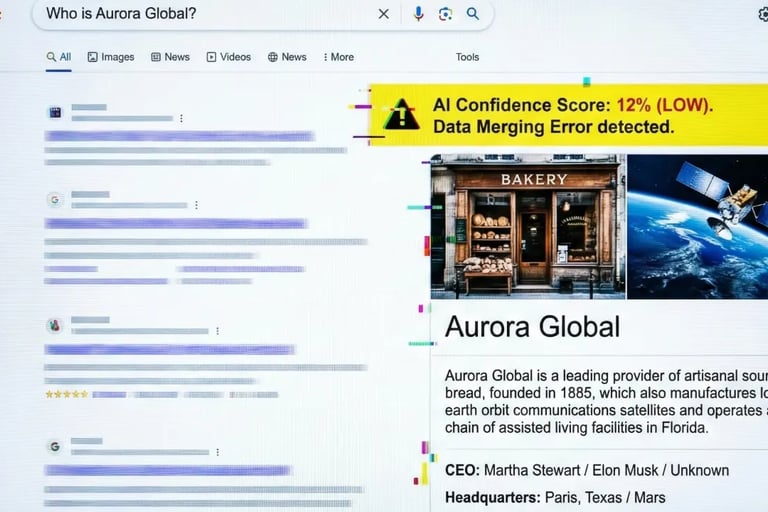
The "Frankenstein" Effect: Without this data, AI models are prone to "Attribute Injection." This is where the AI takes the CEO of Company A and assigns them to Company B because their "vectors" are too close.
The Cost: Imagine a potential investor seeing your competitor's bankruptcy filing attached to your company profile in an AI summary.
The Agentic Future: Soon, AI agents will buy services on behalf of humans. An agent tasked with "Find a B2B agency in Florida founded after 2020" will rely entirely on structured data. If your "About" page is just stories, you are invisible to the agent.
Citation: Research into LLM extraction confirms structured text yields significantly higher accuracy than narrative. Source: Cornell University - LLM Information Extraction
About the Author:
S. Matthew Cohen
A Fractional CXO and the Founder of ConjureSales.com. With a track record of generating doubling and tripling revenue for B2B clients, he specializes in "Semantic SEO" and Revenue Operations. S. Matthew helps entrepreneurs bridge the gap between traditional sales strategies and the new "Machine Economy," ensuring their businesses remain visible and viable in an AI-first world. You can connect with him at linkedin.com/in/smatthewcohen


Address
New York, NY
Contact
646-504-7704
yes@conjuresales.com